

In Slovakia, one in two women has experienced violence at the hands of a partner or spouse. Although men are generally more likely to be victims of certain crimes, women make up the majority of victims of domestic violence. In addition, they often experience violence because society downplays or overlooks it, and perpetrators are not always punished appropriately. That is another reason why it is important to speak out about violence against women and to take a public stand against it. These topics were the focus of a discussion titled “Men’s Actions, Women’s Responsibility?” at Martinus in Košice.
The Brána do života Women’s Shelter and the Fenestra organization held their already second discussion in Košice (June 2, 2026) on the topic of violence against women and what a healthy relationship should look like. At the speakers’ podium took their seats Silvia Králová from Fenestra and psychologist Judita Majerová from Brána do života. Upre women were there.
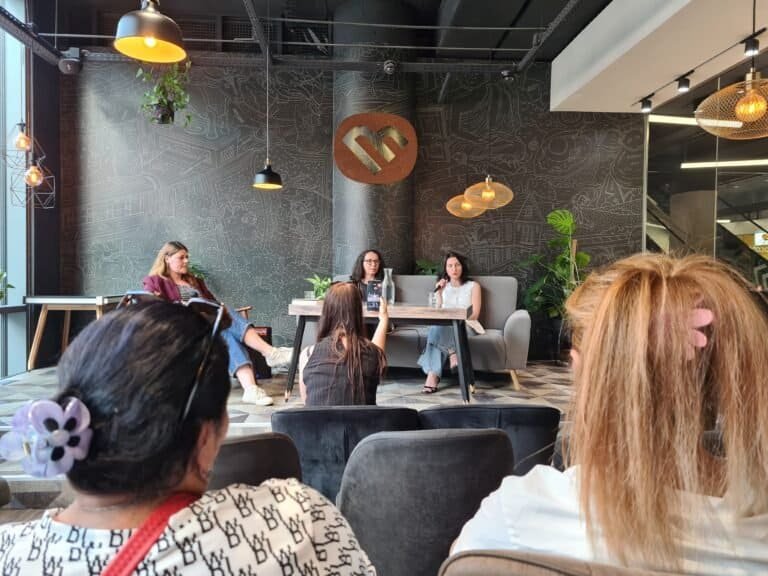
“According to police statistics, one woman dies every day around the world at the hands of her partner.” With this excerpt from the book It Was Love, moderator Laura Fojtová from Brána do života started the discussion. She thus introduced a debate on why we focus primarily on violence against women, why this happens to women, and what we can do about it. Silvia Králová explained right at the outset that this is not a problem specific to individual women: “It is deeply rooted in our culture that men have more power. This inequality is then reflected in relationships between men and women, and we need to gradually change that. Because as long as we are not equal and as long as women continue to experience domestic violence, our society will never be free.” Judita Majerová also weighed in on this topic: “We see the unequal distribution of power between men and women in everyday life. Just consider their representation in top positions, such as in the government. If there is such a significant imbalance there, then even decisions that affect us all are made solely on the basis of male experience, not female experience.”
Gender Inequality as a Cause of Violence
“We raise girls to know what they must and must not do, and boys to know what they can and do not have to do,” explained Silvia Králová on the topic of gender stereotypes: “Of course, men also face various pressures and stereotypes from an early age (be strong, don’t cry), but in general, it is women who suffer from them the most.” Silvia emphasized that this results in alarming numbers of female victims of domestic violence.
A woman experiences violence simply because she is a woman
As for domestic violence against women, the numbers have risen in recent years, and we are above the European Union average. Various studies are currently underway to find answers to the question of why this is the case. According to Silvia, there may be one positive aspect to this: “Women have started talking more about violence.”
Are alcohol and personality disorders just excuses?
“He’s a good guy; he just had a few drinks and lost his temper.” We often hear this in defense of men who have attacked their partners. But according to Silvia, the problem isn’t alcohol itself or a personality disorder: “A man can lose his temper in a store, at a government office, or at work, and it wouldn’t occur to him to lash out at a coworker or a clerk. He behaves that way at home because he thinks he can, and he learns that behavior from his social bubble (family, school, friends…). So the problem isn’t alcohol, but a sense of power.” According to Silvia, violence is deliberate and controlled, and this is evident even in cases where a man deliberately attacks his partner only on parts of the body that aren’t visible.
According to Silvia and Judita, alcohol, drugs, and a lack of emotional control are just excuses and myths that we use to justify and downplay violence. This leads to a situation where perpetrators are not held accountable; on the contrary, we shift the blame for the violence onto women: “Why did you marry him?” “You must have provoked him somehow,” and so on.
What can we do about it?
There are various organizations in Slovakia that are dedicated not only to supporting and assisting women who are experiencing intimate domestic violence, but also to prevention. We can all do our part by speaking out about these issues and standing up for women who experience violence—not only physical, but also emotional (humiliation, manipulation, isolating a woman, etc.), economic (unwittingly putting a partner into debt, etc.), social (controlling a partner’s phone, movements, etc.), digital (e.g., publishing intimate material without consent), and so on.
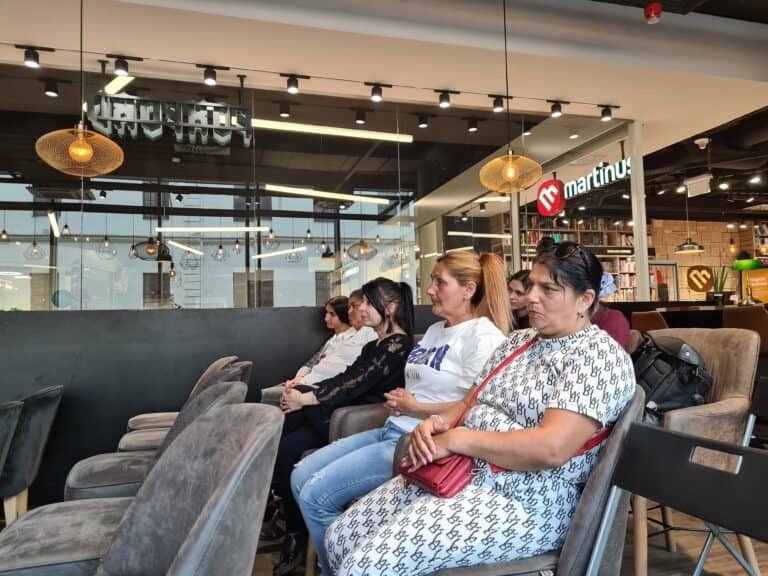
And what does UPre Women have to say about this?
Any woman can experience domestic violence, regardless of where she comes from or the circumstances in which she lives. However, poverty and low socioeconomic status further increase the risk of intimate partner violence. Financial stress, unemployment, and uncertainty increase tension within the household while simultaneously reducing a woman’s ability to leave the relationship. That is one of the reasons why the topics of gender equality and domestic violence are part of our educational program. The discussion at Martinus was an additional opportunity to talk about this and, at the same time, socialize in a pleasant setting full of books and inspiration.
Olga, for example, realized that women also commit violence against their partners, and Magda was struck by the fact that stalking (e.g., by a former partner) is also a form of violence that should be addressed.
We would like to thank Fenestre and Brána do života for bringing these issues to the public’s attention and calling for society-wide change.
Note: In this article, we used data from a European Commission survey—the Survey on Violence Against Women—published on the occasion of the International Day for the Elimination of Violence Against Women (November 25, 2024).
The results showed that as many as 50% of women and girls in Slovakia have experienced partner violence, while the Europe-wide average was 31%. Overall, 38% of women and girls in Slovakia reported experiencing violence (not limited to intimate partner violence) (European average: 31%). Prieskumu sa zúčastnilo aj 5 000 slovenských žien, z ktorých 11 % potvrdilo skúsenosť s agresiou od partnera za posledných 12 mesiacov (celoeurópsky priemer: 5 %).
Read the report on the first discussion HERE.